When you’re buying a house, the general home inspection covers a lot of ground in a few hours: roof, foundation, electrical, plumbing, heating. Gas piping gets a look too, but usually only the parts the inspector can see, and usually without a pressure test. For an older house, or one that’s had gas appliances added over the years, that can leave real problems hidden behind the walls.
Time is the other issue. The standard Washington inspection addendum gives buyers 10 days by default to finish their inspections and ask for repairs, unless your agent wrote in a different number. If you want a closer look at the gas system, it needs to happen fast. Here’s what a dedicated gas line inspection covers, what we find most often in Western Washington homes, and how to use the results.
What a home inspector checks (and what they don’t)
Washington licenses home inspectors and sets standards for what they have to look at. On the gas side, that generally means the heating equipment, venting, the water heater and whatever piping is readily accessible. Plenty of inspectors carry a handheld gas detector and will flag an obvious leak or a rusty pipe.
What they’re not required to do is just as important. The state standards say inspectors don’t have to operate gas shutoff valves, and they don’t evaluate systems that aren’t readily accessible. A full pressure test of the gas system isn’t part of a standard home inspection. When an inspector sees something that worries them, the report will usually say to have a qualified gas contractor evaluate it. That’s the point where we come in.
What a gas line inspection adds
A gas line inspection follows the whole system, from the meter to every appliance. On a typical single-family home, ours takes one to two hours and covers:
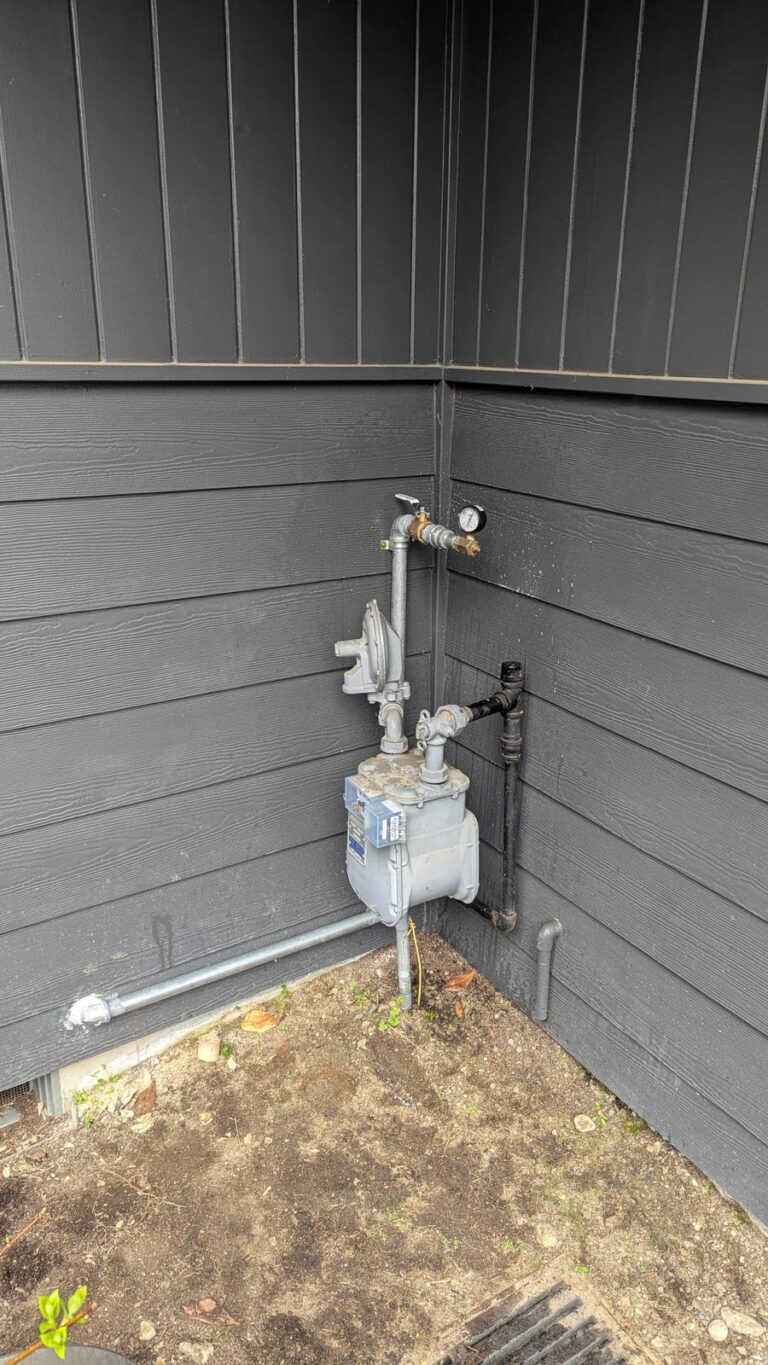
- The meter, regulator and exterior piping, checked for corrosion and damage
- All visible interior piping, checked for leaks, wrong materials and poor support
- A pressure test of the system to find leaks in sections we can’t see
- Every appliance connection, checked with an electronic leak detector
- The main shutoff, each appliance shutoff and the seismic shutoff valve if there is one
- Flexible appliance connectors, checked for age, type and kinks
You get a written report of what we found and what we’d recommend fixing, which you can hand straight to your agent.
How the pressure test works
We shut off the gas at the meter, put a gauge on the system and watch it for a set period. If the pressure holds, the piping is tight. If it drops, there’s a leak somewhere, even if it’s inside a wall or under a floor. From there we track down the source with an electronic detector and leak-check solution at the fittings.
Because the gas has to be off for a short time, the seller needs to agree to the test. Your agent can arrange that when they schedule access. We relight the pilots and check the appliances before we leave.
In escrow and short on time?
Call us as soon as your offer is accepted. We schedule pre-purchase gas inspections around inspection deadlines and send the written report quickly.
Problems we find most often
Most houses we inspect are in decent shape. When something does turn up, it’s usually one of these.
Old brass appliance connectors
Older appliances are sometimes still hooked up with uncoated brass flexible connectors. The Consumer Product Safety Commission warned years ago that these can crack or pull apart at the fittings when the appliance gets moved, and recommended replacing them with coated or stainless steel connectors. If the range or dryer has been in the house a long time, this is one of the first things we look at.
Unbonded yellow CSST
CSST is the flexible stainless gas tubing with a yellow plastic jacket, and it’s common in homes built or remodeled since the 1990s. The yellow-jacketed type has to be bonded to the home’s electrical grounding system with a heavy copper wire, because a nearby lightning strike can arc through unbonded tubing and puncture it. We find plenty of systems where that bond is missing. It’s usually a simple fix, but it shouldn’t be skipped.
Corrosion at the meter and where pipe meets the ground
Our wet climate is hard on exterior steel pipe. We look closely at the meter set, the riser and anywhere steel pipe passes through soil, concrete or a damp crawlspace. Surface rust is normal. Pitting or flaking at a joint means that section should be replaced.

Missing sediment traps
A sediment trap, also called a drip leg, is a short capped pipe at the appliance connection that catches debris before it reaches the gas valve. Code calls for one at furnaces, water heaters and similar appliances. They’re often left off in older installs and DIY replacements.
Open or abandoned gas lines
When a gas range gets swapped for electric or an old gas dryer leaves the laundry room, the line behind it sometimes ends at a valve with nothing on the end. One bump of that handle and gas flows into the room. Every unused outlet should be capped or plugged. If you ever do smell gas in the house, our post on the signs of a gas leak covers what to do.
Signs of unpermitted work
Gas lines added for a fireplace, a kitchen remodel or a garage heater are where we most often find shortcuts: fittings that aren’t allowed inside walls, pipe hanging without support, or lines too small for the appliance. Ask the seller whether permits were pulled for any gas work. In Seattle and unincorporated King County, gas piping permit records are kept by Public Health – Seattle & King County. Elsewhere, check with the city or county permit office.
We also note whether the water heater is strapped for earthquakes and whether the house has an automatic seismic gas shutoff valve. Code requires water heater strapping here. The shutoff valve is optional in most places, but buyers often ask about it. Our guide to earthquake gas shutoff valves explains how they work and what they cost.
Using the report in your purchase
Small issues like a loose fitting or a missing cap can often be fixed on the spot during the inspection, with the seller’s OK. For anything bigger, we give you a written estimate so you know what the repair costs. You and your agent can then ask the seller to make the repair, offer a credit, or adjust the price.
If your general home inspector has already flagged a gas concern, the standard Washington addendum lets you request an additional inspection by a specialist. It comes with a short extra window, five days by default, so you’re not stuck deciding on incomplete information. Ask your agent to send that notice right away.
Book a pre-purchase gas inspection
Know what you’re buying before your inspection period ends. We test the whole system, from the meter to every appliance, and give you a written report you can use in negotiations.
We inspect homes across King, Snohomish and Skagit counties. See everything our inspection covers on our gas inspections and maintenance page.
Common questions
How long does a gas line inspection take?
One to two hours for most single-family homes. Houses with a lot of gas appliances, outdoor lines or multiple units take longer.
Does the seller have to be home?
No, but the seller has to approve access and a short gas shutoff for the pressure test. Your agent usually handles both when scheduling.
Is a gas inspection worth it on a newer house?
It matters most for older homes, houses with remodels or additions, and any house where gas appliances were added over the years. A newer home with its original permitted piping is lower risk, though a CSST bonding check is still worthwhile.
Do you inspect propane systems?
Yes. We inspect natural gas and propane systems, including rural properties in Snohomish and Skagit counties that run on a propane tank. Propane runs at a higher pressure, so we adjust the test for it.