A natural gas fire pit is about as low-effort as backyard fire gets. You turn a key or press a button, the flames come up, and when you’re done you shut it off. There’s no wood to stack and no smoke drifting into the neighbor’s windows. And unlike propane, the gas never runs out halfway through the evening.
Getting there takes a bit of planning, though. The burner has to match your gas supply, the line from the house has to be sized for it, and around here the whole thing has to survive eight months of rain. Below is what we walk homeowners through before we run a line to a new fire feature.
Natural gas or propane?
If your house already has natural gas, that’s usually the better choice for a built-in fire pit. The supply never runs out, and once the line is in, there’s nothing to refill or haul.
Propane makes sense when there’s no gas at the house, or when the fire pit is far enough from the meter that a long trench gets expensive. Just know how fast a fire pit goes through it. A standard 20-pound tank holds roughly 430,000 BTUs of fuel. A 100,000 BTU burner on high empties it in about four hours, which is one or two evenings outside. A larger tank plumbed in by a pro solves that, but it’s still something to refill.
The two fuels aren’t interchangeable. Natural gas runs at a much lower pressure than propane, so burners use different orifices, and sometimes different valves, for each one. Some propane fire pits can be converted with the manufacturer’s kit, and some can’t. If you already own a propane unit and want to switch, check the model before you plan around it.
Sizing the burner and the gas line
Fire pit burners are rated in BTUs per hour. A small fire table insert might run under 100,000 BTUs. The large brass burners in custom fire pits can be rated at 200,000 to 300,000 BTUs or more. That’s more gas than a furnace and a water heater use combined.
The bigger the burner and the farther it sits from the meter, the larger the pipe needs to be. An undersized line gives you a short, lazy flame, and it can starve the other appliances in the house when everything runs at once. For very large burners, the meter itself may need an upgrade from the utility.
That’s why we size the line around the specific burner you’re buying, not a guess. If you haven’t picked one yet, we can help you choose. We’re an authorized Warming Trends dealer, and their CROSSFIRE brass burners are what we install most often. They come in natural gas and propane versions and in a wide range of sizes, so it’s easy to match one to the pit and the gas supply you have.
Planning a fire pit this summer?
Send us a photo of the spot and tell us where your gas meter is. We’ll tell you what the gas line will take and give you a free estimate.
Where to put it
Clearances come from the burner’s installation instructions, and your local fire code can add to them. Manuals commonly call for three to four feet from anything combustible on the sides and seven to ten feet of open space overhead, with bigger burners needing more. That overhead number is what rules out a lot of covered patios and pergolas, so check it before you fall in love with a spot.
A few other things we look at on a site visit:
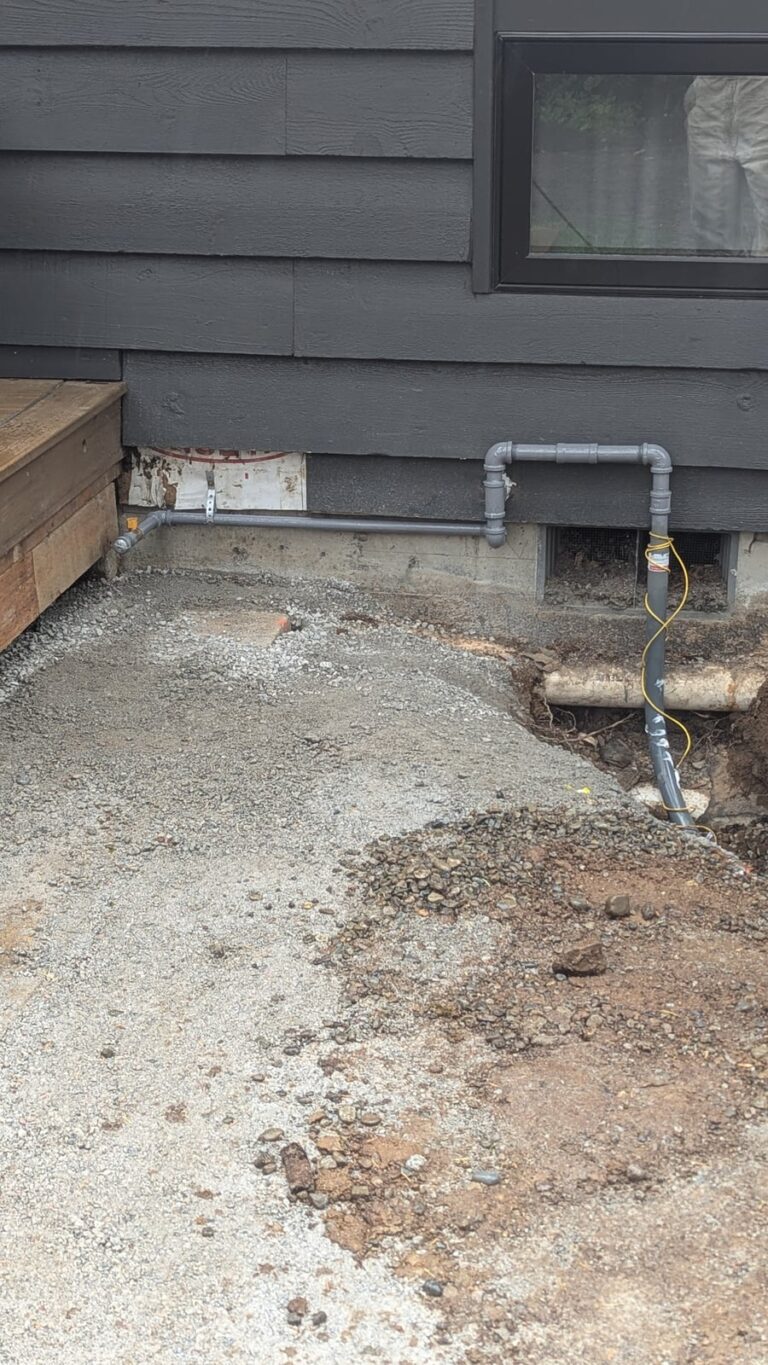
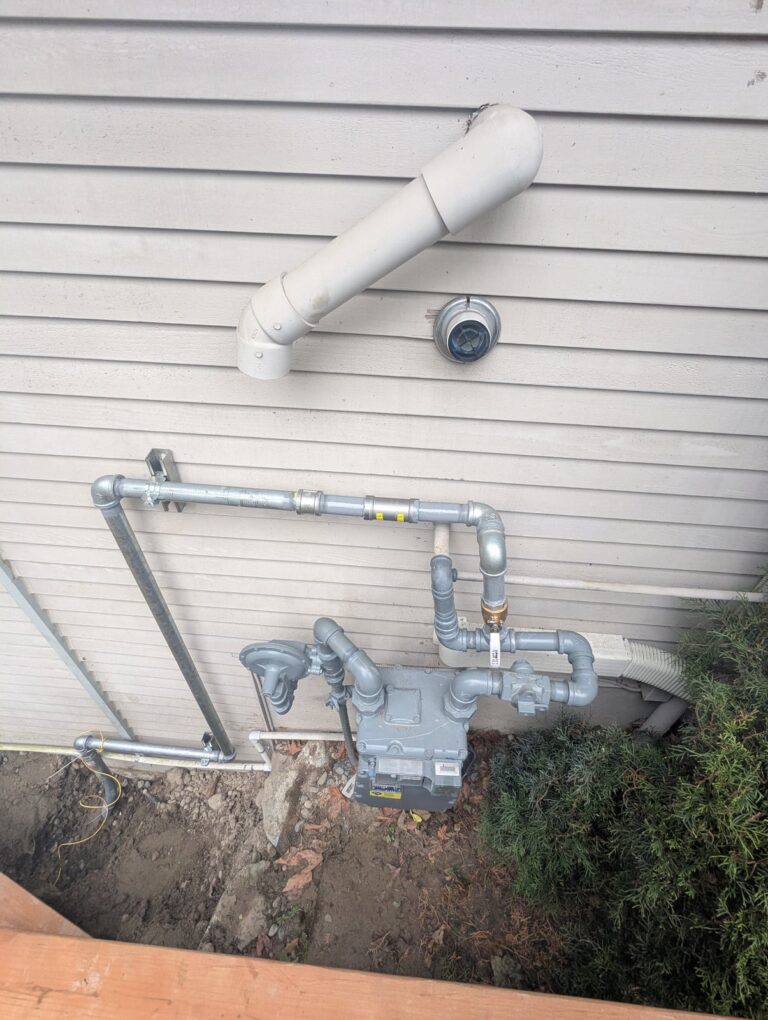
- The route from the gas meter sets much of the cost. A straight run across lawn is quick to trench, while going under a patio, around a retaining wall or across a driveway takes more time.
- Wind in an exposed corner of the yard will push the flame around and can blow out a match-lit burner. A wind guard or a more sheltered spot helps.
- Chairs need to fit comfortably outside the clearance zone, so leave enough room around the pit for seating.
Any trench needs a call to 811 first so buried utilities get marked. We handle that as part of the job.

Building it for Western Washington rain
This is the part that gets skipped in fire pit guides written for Arizona. A built-in pit is basically a bowl, and if the burner pan holds water, the burner and ignition sit in a puddle all winter. That leads to rust, corrosion and an ignition system that quits after a season or two.
The fix is drainage. The pit needs a way for water to get out, usually a gravel base with weep holes or a drain, and the burner pan should sit above wherever water collects. A layer of lava rock under the decorative media helps water move through instead of pooling.
Materials matter too. Solid brass burners hold up well in wet weather, which is one reason we like them. A fitted cover for the off-season keeps leaves and standing water out, and it’s worth the money.
Choosing an ignition
There are three common ways to light a gas fire pit:
- A match-lit burner is the simplest and cheapest. You open the valve and light it with a long lighter, and it needs no power. The catch is that nothing shuts the gas off if the flame goes out.
- Spark ignition adds a push-button igniter. It’s more convenient than a lighter and still doesn’t need an outlet.
- Electronic ignition with flame sensing lights from a switch or remote, and if the flame goes out, it shuts off the gas. Warming Trends offers a battery-powered version, so you don’t need to run electrical out to the pit.
If kids or pets use the yard, or the pit is somewhere you can’t always see it from the house, flame sensing is worth the extra cost.
Gas fire pits and summer burn bans
Late summer usually brings burn bans to King, Snohomish and Skagit counties. People often assume a gas fire pit is always exempt. Sometimes it is and sometimes it isn’t.
The rules depend on who issued the ban and what stage it’s at. Some bans have allowed gas fire tables and other devices that shut off instantly, while banning wood fires. The strictest ones prohibit recreational fires of any kind. Before you light up during a dry spell, check your county fire marshal’s page or the Puget Sound Clean Air Agency. Burning during a ban can bring a $1,000 penalty.
What a natural gas fire pit costs
Think of it as two separate costs: the fire feature and the gas line to it.
The fire feature can be a pre-built fire table, a burner kit dropped into a pit your landscaper builds, or a fully custom stone pit. Prices range widely depending on size, materials and ignition type.
The gas line for a typical backyard fire pit usually runs about $600 to $1,300, including the trench. Longer runs, boring under hardscape, or a large burner that needs bigger pipe push it higher. A permit adds to that. We break down the line cost in more detail in our guide to gas line installation cost in the Seattle area.
Adding patio heaters or a grill on the same line
If you’re trenching to the patio anyway, think about what else you might want out there. Natural gas patio heaters, a built-in grill or an outdoor kitchen can all be fed from the same run if the pipe is sized for the combined load. A quick-connect outlet near the patio is also handy for a portable heater or grill you want to move around.
Planning all of it now costs far less than trenching the yard a second time next year. Our appliance hookups page lists the outdoor equipment we connect.
Get your fire pit gas line priced
We can supply the Warming Trends burner, run and permit the gas line, and connect everything in one project. Tell us about the space and we’ll put together a free estimate.
We install fire features across King, Snohomish and Skagit counties. See the burners we carry on our Warming Trends page.
Common questions
Do I need a permit for a natural gas fire pit?
For the gas line, yes. Running new gas piping to a fire pit needs a permit and an inspection in Western Washington. We pull the permit and schedule the inspection as part of the job.
Can I convert my propane fire pit to natural gas?
Often, but not always. Many burners can switch fuels with the manufacturer’s conversion kit, which changes the orifice and sometimes the valve. Others need a new burner. Send us the make and model and we’ll tell you which yours is.
Does a gas fire pit put out much heat?
It depends on the burner size. A small fire table is mostly for looks and warms the people sitting right next to it. A large burner throws real heat. If staying warm on cool evenings is the main goal, size up the burner or add a patio heater nearby.
Should I use fire glass or lava rock?
Either works on top. Lava rock costs less and makes a good base layer for drainage, and fire glass is the more decorative finish. Many people use lava rock underneath and glass on top. Whatever you choose, use media made for gas fire features, since ordinary rocks and gravel can crack or pop when they heat up.