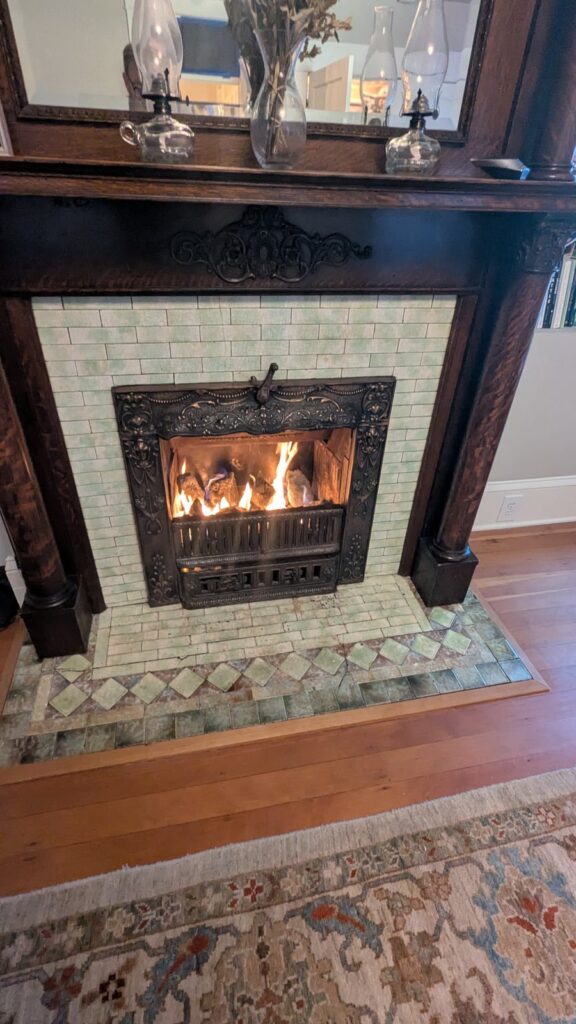
Plenty of older homes around Puget Sound have a masonry fireplace that hardly gets used. Hauling and drying firewood is a chore. An open fireplace sends most of its heat straight up the chimney. And on the cold, still nights when you’d most want a fire, there’s a decent chance an air quality burn ban is in effect.
Converting to gas fixes most of that. You get a fire at the push of a button, far more heat in the room if you choose the right setup, and a fireplace you can still use when wood burning is restricted. Here’s how the options compare, what goes into the gas line and chimney side of the job, and roughly what it costs.
Your options: gas logs, an insert or a new fireplace
Gas log set
A gas log set is a burner and ceramic logs that sit in your existing firebox. It’s the simplest and least expensive conversion, and a good set looks convincing. The catch is heat. Vented gas logs need the chimney damper open whenever they’re in use, and it’s usually clamped open permanently, so much of the warmth still goes up the flue, same as a wood fire. Logs are mainly about the look of a fire.
Gas fireplace insert
An insert is a sealed firebox with a glass front that slides into your existing fireplace opening. Most are direct-vent, which means two flexible liners run up the inside of the chimney: one pulls in outside air for combustion and the other carries exhaust out. Because the firebox is sealed and most models have a blower, an insert puts real heat into the room. If you want the fireplace to help heat the house, this is the option to choose.
New built-in gas fireplace
No fireplace at all? A zero-clearance, direct-vent gas fireplace can be framed into a wall and vented straight out the side of the house or through the roof, with no chimney needed. It’s more of a construction project, but it puts a fireplace anywhere you want one. For these, we run the gas and work alongside the fireplace dealer or contractor who frames and finishes it.
What about vent-free units?
Vent-free gas logs and fireplaces have no flue at all. They release their combustion byproducts, including a lot of water vapor, into the room. We generally steer people away from them here. Western Washington houses already fight indoor moisture, and some local codes restrict where these units can go.
Why gas makes sense during burn bans
Fall and winter burn bans around Puget Sound are about air quality. When smoke gets trapped close to the ground during cold, stagnant weather, the Puget Sound Clean Air Agency calls a burn ban. During a Stage 1 ban, wood fireplaces are off limits, but natural gas and propane stoves and inserts are still allowed. If you count on your fireplace for winter evenings or some backup heat, a gas insert keeps working on the nights a wood fire can’t.
Thinking about switching your fireplace to gas?
Send us a photo of the fireplace and tell us where your gas meter is. We’ll tell you what the gas line will take and give you a free estimate.
Running the gas line to the fireplace
Compared to a fire pit or a generator, a fireplace is a modest gas load. Most residential inserts are rated somewhere around 20,000 to 40,000 BTUs, so a branch off your existing gas piping usually handles it without upsizing anything.
The route is what decides how easy the job is. A ground-floor fireplace over a crawlspace or unfinished basement is the simple case: we run the line underneath and bring it up into the firebox. A fireplace on a slab or a second floor takes more work to reach, and sometimes the line has to run up an exterior wall or through a finished space. Either way, the fireplace gets its own shutoff valve, and we pressure-test the line before the insert or logs go in.
One detail people don’t expect: most inserts need a standard 120-volt outlet for the blower, and many old masonry fireplaces don’t have one nearby. If yours doesn’t, plan for an electrician to add it before the insert is installed.
No natural gas at the house? Most inserts and log sets also come in propane versions, fed from an outdoor tank.
Getting the chimney ready
Before an insert goes in, the chimney should be inspected and swept. Years of wood fires leave creosote behind, and any cracked flue tiles or loose masonry should be repaired first. The insert’s liner runs the full height of the chimney, so the chimney itself needs to be sound.
For gas logs, the chimney is still the flue, so it needs to be clean and drawing well. We coordinate with chimney professionals when an inspection or repair is needed, so the work happens in the right order.
What it costs
Costs vary with the unit you pick and the shape your chimney is in, but these are typical ranges:
| Item | Typical cost |
|---|---|
| Gas line to the fireplace | $500 to $1,000+ |
| Chimney liner for an insert | $500 to $1,500 |
| Gas fireplace insert, installed (unit, liner and labor) | $3,000 to $8,000 |
Gas log sets usually come in well under the cost of an insert. A new built-in fireplace costs more than either, because of the framing, venting and finish work. Add a permit for the gas piping, and an electrician if you need an outlet.
The gas line is the piece we price. A long run, or getting gas to a second-floor fireplace, pushes it toward the high end. For more on what moves gas line pricing, see our guide to gas line installation cost in the Seattle area.
Plan before the cold sets in
Fireplace work gets busy once the weather turns. Inserts often have to be ordered, chimney sweeps book up, and everyone wants their fireplace working by the first cold snap. If you’re converting this year, pick the unit early and get the gas line roughed in so it’s ready when the insert arrives.
Get your fireplace gas line scheduled
We run and permit the gas line, install log sets and inserts, and coordinate with your dealer or chimney sweep. Get a free estimate before the fall rush.
We connect fireplaces, inserts and other gas appliances across King, Snohomish and Skagit counties. See the full list on our appliance hookups page.
Common questions
Can I put gas logs in my wood-burning fireplace?
Usually, yes, as long as the chimney is in good shape and drafting properly. We run the gas line into the firebox and install the burner, valve and logs. Just remember the damper stays open, so logs are more about looks than heat.
Is an insert worth the extra cost over gas logs?
If you want the fireplace to warm the room, yes. An insert’s sealed firebox and blower put far more of the heat into the house. If you mostly want the look of a fire a few nights a year, logs are fine.
Do I need a permit?
The gas piping needs a permit and an inspection, which we handle. Depending on where you live, installing the insert itself may need its own permit as well.
Will a gas fireplace work during a power outage?
Many will. Log sets and inserts with a standing pilot or millivolt valve light without household power, though the blower won’t run. Units with electronic ignition often have a battery backup. If outage heat matters to you, ask about it when you choose a model. If keeping the whole house running during outages is the bigger goal, our guide to standby generator gas lines covers that side.