Tankless water heaters have a lot going for them: endless hot water, a unit the size of a carry-on bag hanging on the wall, and no tank to leak in the basement after 12 years. Plenty of homeowners decide to make the switch when their old tank starts to go.
What surprises most of them is the gas line. A tankless heater uses far more gas while it’s running than a tank ever did, and the pipe that fed your old water heater almost never keeps up. Here’s why, what else changes in a tankless install, and what to budget.
Why tankless heaters need so much gas
A tank water heater heats water slowly and stores it. A typical 40- or 50-gallon gas tank uses around 40,000 BTUs an hour. A tankless unit heats water instantly as it flows through, so it needs a lot of heat in a short burst. Whole-house tankless models are commonly rated somewhere between 150,000 and 199,000 BTUs.
That’s four or five times the gas of the tank it replaces. When two showers and the dishwasher are running on a cold morning, the furnace may be firing at the same time too. The gas piping and the meter both have to handle that combined load.
What usually needs to change in the gas line
Most tank water heaters are fed with half-inch pipe, and that’s rarely enough for a tankless unit. Manufacturers list a minimum pipe size and gas pressure in the installation manual, and if the line can’t deliver it, the heater may throw error codes, run lukewarm when demand is high or shut down altogether.
The fix is usually larger pipe from the water heater back toward the meter, or sometimes a new dedicated line. How much pipe has to change depends on the distance and on everything else connected to the system. We size it from the heater’s specs and your other appliances, so the new line holds up on the coldest, busiest morning of the year as well as on a quick test run.
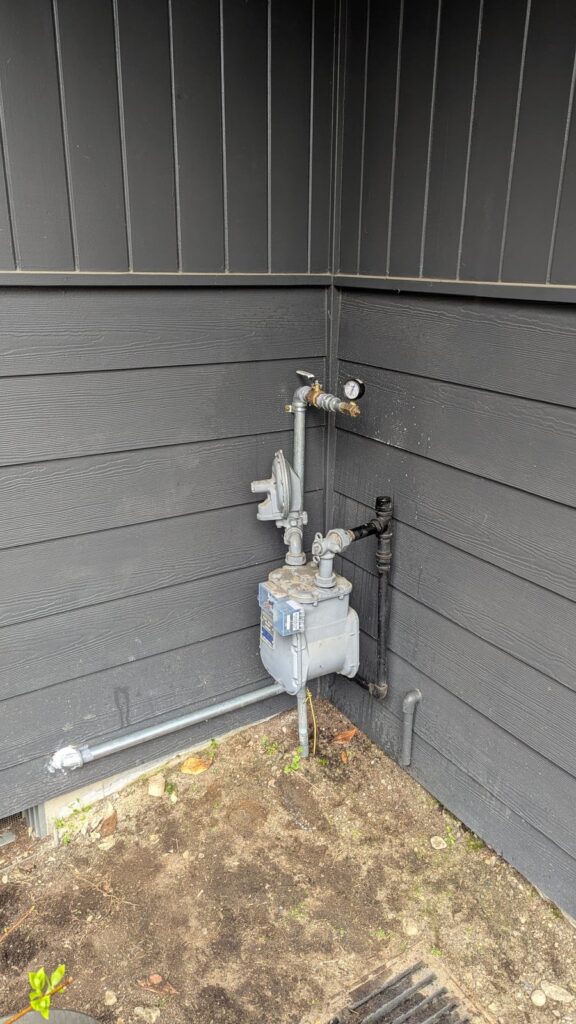
The meter is the other piece. If your home already has a furnace, range, dryer and fireplace on gas, adding a 199,000 BTU water heater can push the total past what the meter is rated for. Then the utility has to install a bigger meter, and only the utility can do that. We check it up front so it doesn’t hold up the job.
Switching to tankless?
Send us the model you’re considering and a photo of your current water heater and meter. We’ll tell you what the gas line needs and give you a free estimate.
Other things that change with tankless
Venting
Your old tank probably vented into a metal flue or chimney. Tankless units need their own venting, and the old flue usually can’t be reused. Condensing models, the more efficient kind, vent through PVC pipe and can often go straight out a nearby wall. Non-condensing models need special stainless vent pipe. The vent route has a big effect on where the heater can go and what the install costs.
Power and a condensate drain
Tankless heaters need a 120-volt outlet for their controls and fan. That also means no hot water during a power outage unless you have a backup power source, which is worth knowing in a region where winter windstorms take out power for days. Condensing units also produce acidic condensate that needs a drain, usually with a neutralizer.
Maintenance
Minerals in water build up inside a tankless heat exchanger over time, so manufacturers call for periodic flushing. Here we get a break. Seattle and Everett both have soft water, so scale builds up much more slowly than in hard-water parts of the country. It’s still worth following the maintenance schedule for your model, especially if you’re on a well.
Where the heater can go
Because a tankless unit hangs on the wall, you have more freedom than with a tank. The garage, a utility room, a basement wall or a closet can all work, as long as the vent can reach outside within the manufacturer’s limits and the gas line can get there at the right size. Some models are built to mount on an exterior wall, which saves indoor space and simplifies venting. Outdoor units rely on electric freeze protection, though, so a long outage during a cold snap is something to think about.
Moving the water heater to a new spot can make sense, but every foot of new gas line, water line and vent adds cost. Often the simplest plan is mounting the new unit close to where the old tank stood.
Permits
Replacing a water heater requires a permit in most of Western Washington, and so does any change to the gas piping. In Seattle and unincorporated King County, both go through Public Health – Seattle & King County. Elsewhere, it’s usually your city or county. The inspection checks the gas line, venting and connections, and it’s one of the things home buyers’ inspectors look for later.
What it costs
Replacing a tank with a gas tankless heater commonly costs $3,000 to $7,000 or more installed. The unit itself is only part of that. Venting and gas line upgrades are the biggest variables, and they’re why two quotes for the same heater can be far apart.
The gas line portion depends on how much pipe needs upsizing. A short run near the meter might be a few hundred dollars. Replacing a long stretch of pipe, or running a new dedicated line, can be $1,000 or more. A meter upgrade from the utility would be a separate item. Our guide to gas line installation cost in the Seattle area covers what drives gas line pricing in more detail.
When you compare quotes, check whether each one includes the gas line upgrade, the new venting and the permit. A low price that leaves out the gas work isn’t really a lower price.
Get the gas line right for your tankless heater
We size and upgrade gas lines for tankless water heaters, check meter capacity and handle the permit, working alongside your plumber or installer.
See the appliances we connect on our appliance hookups page.
Common questions
Can I use my existing gas line for a tankless water heater?
Rarely as-is. The half-inch line that fed a tank usually can’t supply a whole-house tankless unit, especially if the run is long or other appliances share the line. A quick look at the pipe size, distance and your other appliances tells us what needs to change.
What size gas line does a tankless water heater need?
Often three-quarter-inch or larger, but it depends on the heater’s BTU rating, the length of the run and the total load on the system. The manufacturer’s manual lists the minimum, and we size the line to meet it with everything else running too.
Is a tankless heater worth it?
For households that run out of hot water or want to free up floor space, often yes. Tankless units also last longer than tanks in most cases. The trade-off is a higher upfront cost and the need for power to make hot water.
Will a tankless heater work on propane?
Yes. Most models come in propane versions. The propane line and tank need to be sized for the heater’s demand, the same way a natural gas line does.